John Whitehead's Commentary
Betraying America’s Military and the Constitution They Swore to Defend

“The era of the Department of Defense is over… From this moment forward, the only mission of the newly restored Department of War is this: warfighting… We untie the hands of our warfighters to intimidate, demoralize, hunt and kill the enemies of our country… You kill people and break things for a living.” — Pete Hegseth
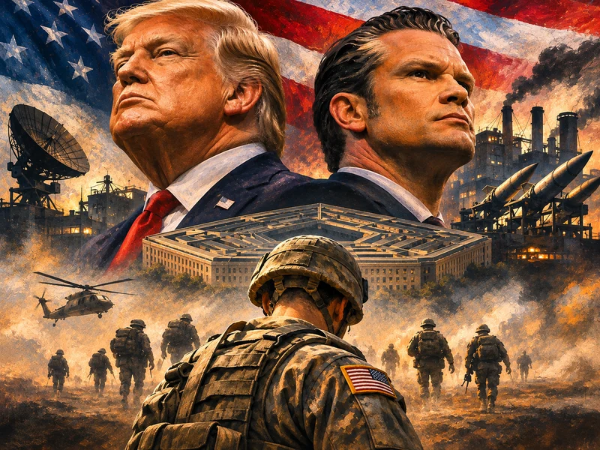
Donald Trump and his administration have done a grave disservice to America’s military.
By politicizing the military, sending service members into wars of questionable legality, attempting to use military forces against American citizens, and seeking to punish veterans who exercise their constitutional rights, the Trump administration has attempted to turn the U.S. military into its own guns-for-hire battalion.
This is not how you honor America’s military.
Pete Hegseth has done an even graver disservice to the men and women who serve.
Having called for a “warrior ethos” that celebrates aggression, lethality and an unquestioning commitment to warfighting, the self-styled Secretary of War has repeatedly demonstrated a troubling disregard for the constitutional safeguards meant to govern the military’s use of force.
Consider his record.
Hegseth fired the military’s top uniformed lawyers—the very officers charged with ensuring that military operations and orders comply with the law—complaining that legal advisers should not become “roadblocks.”
He shared sensitive operational details about impending military strikes in Yemen over an unauthorized Signal chat, exposing military personnel and missions to potential danger. The Pentagon’s own inspector general subsequently found that he had violated departmental security protocols.
He imposed sweeping restrictions on Pentagon journalists, limiting independent scrutiny of military operations and prompting a federal court to find that the department’s press restrictions violated the First Amendment.
He sought to punish retired Navy captain and Senator Mark Kelly for reminding service members of their duty to refuse unlawful orders, threatening his military rank and retirement pay until a federal judge intervened.
He has used the Pentagon to promote his particular brand of Christianity, hosting Christian worship services, inviting a Christian nationalist preacher into the halls of military power, and overhauling the military’s chaplaincy system in ways that have raised serious concerns about the religious freedom of service members who do not share his beliefs.
He has invoked the Crusades as a model of religious struggle, defended the Christian warriors who fought them, and called for pushing back against “Islamism” culturally, politically, geographically and militarily. Even as American troops wage war against Iran, Hegseth has invoked biblical warfare and prayed at a Pentagon service for overwhelming force against enemies he described as deserving “no mercy.”
And he has overseen military operations in Iran, Yemen and the Caribbean that have raised serious questions about congressional war powers, civilian casualties and the legality of deadly force—including so-called “kinetic” strikes on suspected drug-smuggling vessels that have prompted allegations of war crimes and demands for legal accountability.
Now, faced with eight articles of impeachment introduced by Rep. Thomas Massie (R-Kentucky), Hegseth has dismissed the effort as an act of “sabotage,” suggesting that holding military leaders accountable amounts to punishing the troops who carry out their orders.
Questioning the war makers is not an attack on the troops. It is one way of defending them.
The charges at the heart of Massie’s impeachment effort speak to an identity crisis under Hegseth’s leadership—one that pits the Founders’ vision of a military that exists to defend the Constitution and a constitutional form of government against a version of the military as a ruthless killing machine whose purpose is to invade, intimidate, and destroy the president’s enemies.
America’s service members represent different religions, political beliefs and walks of life, but they are bound by a common oath: to support and defend the Constitution.
Unfortunately, while Hegseth and the rest of the Trump administration pay lip service to the Constitution, their actions have repeatedly raised questions about whether they believe its restraints apply to them.
Three of Massie’s eight articles of impeachment accuse Hegseth of violating separate provisions of the War Powers Resolution by waging war against Iran without congressional authorization, continuing hostilities despite Congress’s direction to withdraw U.S. forces, and refusing to terminate military operations after the expiration of the law’s 60-day limit and potential 30-day withdrawal period.
The remaining five accuse Hegseth of disregarding laws meant to protect civilians during military operations; authorizing extrajudicial killings of suspected drug traffickers at sea; retaliating against Senator Mark Kelly for exercising his First Amendment rights; directing the military operation to seize Venezuelan leader Nicolás Maduro and his wife, Cilia Flores, without lawful authority; and waging an unauthorized military campaign in Yemen.
Hegseth wants to dismiss the impeachment effort as a disagreement over military policy, but this is about something far more fundamental than one man’s job or one administration’s military strategy.
It is about the constitutional balance of power.
For decades, presidents of both political parties have treated Congress’s war powers as little more than an inconvenience, while Congress has repeatedly allowed its constitutional authority to be diminished.
Impeachment is not a criminal prosecution. It is one of the mechanisms the Founders provided for holding public officials accountable for serious abuses of power.
If Congress will not defend its own constitutional authority over war, who will?
That question goes to the very heart of the constitutional crisis confronting the American military.
The Founders understood the danger of concentrating military power in the hands of a government that answers to no one. They feared standing armies that could be used to subjugate the population, and they sought to prevent the machinery of war from becoming the personal instrument of a president.
Yet that is precisely the direction in which the government has been moving.
For decades, military tactics developed for foreign battlefields have found their way into American communities. Armored vehicles on neighborhood streets. Militarized police raids. Citizens increasingly treated as enemy combatants rather than individuals with constitutional rights.
Now the Trump administration is attempting to blur the distinction between military operations abroad and civilian law enforcement at home.
In September 2025, Trump told military leaders that American cities could serve as training grounds for military forces. That same month, a federal court ruled that the administration’s use of National Guard troops and Marines for civilian law enforcement in Los Angeles violated the Posse Comitatus Act.
Think about the implications.
The government is asking American service members to defend freedom abroad while using—or preparing to use—them to enforce government power against their fellow citizens at home.
This is precisely the danger the Constitution was intended to guard against.
The Constitution divides war powers between Congress and the president, places the military under civilian authority, and binds those in power to the rule of law.
But those safeguards mean little when Congress refuses to challenge unauthorized wars, presidents treat military force as their private prerogative, and military leaders demand obedience without accountability.
The problem extends far beyond any one president or military campaign.
For decades, the United States has maintained a vast military empire, policing the globe, occupying foreign countries, and waging wars with no clear end in sight. The military-industrial complex has profited enormously from this arrangement, while the men and women in uniform have been left to bear its human costs.
Each new conflict is marketed as national defense. Each demands more money, more weapons, more deployments, and more sacrifices from those expected to fight it.
And it is America’s service members who are treated as pawns in the government’s endless pursuit of global power.
Consider the human price of the war with Iran.
In a November interview with 60 Minutes, President Trump insisted that the conflict with Iran was “not a war” and asserted that the United States had not lost a soldier in the previous five or six months. He then acknowledged 18 deaths across the Iran and Venezuela operations, comparing that number with the much larger losses of earlier wars.
The Pentagon’s own casualty records tell a fuller story.
As of October 29, the government had reported 23 American military deaths connected to the Iran conflict, including hostile and nonhostile deaths, and 865 service members wounded.
Earlier in the war, investigative reporting by The Intercept raised questions about whether the Pentagon was concealing the true extent of American military casualties, citing outdated figures, discrepancies in official reporting, and unanswered questions about the numbers of troops injured and killed.
The American people are entitled to an honest accounting of the lives lost, the injuries suffered, and the financial burden of wars fought in their name.
Unfortunately, Washington has become adept at propagandizing its military interventions as exercises in freedom, security, and national greatness.
Yet for those who will never see their loved ones come home, or who will spend years helping a wounded veteran recover, it makes little difference whether the government calls it a war, an operation, a mission, or a victory—the price is the same.
This is the cruel arithmetic of the American war machine: politicians count votes, military contractors count profits, and military families count the dead.
Follow the money.
The Trump administration has requested another $67 billion for the Pentagon as part of an $87.6 billion supplemental spending package, with billions earmarked for the Iran war. The Congressional Budget Office estimates that replacing munitions expended through August 1 alone could cost more than $21 billion. Meanwhile, major defense contractors, including Northrop Grumman and RTX, have raised their profit forecasts as the Pentagon scrambles to replenish its depleted weapons stockpiles.
The danger is not merely that war has become profitable.
It is that a government increasingly dependent on perpetual warfare may lose the ability—or the willingness—to distinguish the nation’s security from the interests of the institutions that profit from keeping the war machine running.
But who is really calling the shots?
Increasingly, reports from inside the Trump administration have raised troubling questions about whether the president—the nation’s commander-in-chief—even has a full understanding of the military operations being carried out under his command.
In April, The Wall Street Journal reported that Trump’s advisers deliberately kept him out of the room where officials were monitoring the dangerous rescue of two downed American airmen in Iran, providing updates only at critical moments because they feared his impatience would interfere with the mission.
In August, The Washington Post reported that Trump confronted Hegseth over severe munitions shortages, apparently believing that the problem had already been resolved.
Then, in September, The New York Times reported that Vice President JD Vance had taken the unusual step of contacting military commanders directly to obtain unfiltered assessments of the Iran war—assessments that painted a far more troubling picture of the conflict than the administration was presenting publicly.
These reports raise troubling questions about whether Trump was being shielded from unwelcome information, misled about military capabilities, or simply unwilling to confront the realities of the war.
Whatever the reason for the disconnect, the constitutional responsibility remains his.
He is the commander-in-chief.
If Trump does not know what is being done in his name, that is a serious problem.
If Trump knows and permits it to continue, that is a serious problem, too.
And if the president refuses to provide meaningful accountability, Congress has a constitutional duty to demand it.
While the politicians and Pentagon officials maneuver for power, and military contractors reap the financial rewards, it is America’s service members and the American people who bear the consequences.
In the wake of the Iran war, military counseling organizations have reported a surge in requests for help from active-duty personnel seeking conscientious-objector status, discharge options, or guidance about potentially unlawful orders.
These men and women are being asked to carry out decisions they did not make, in wars they did not authorize, under commanders whose own commitment to constitutional restraint is increasingly being called into question.
Their oath is not a pledge of personal loyalty to the president, the defense secretary, or the military-industrial complex. It is an oath to support and defend the Constitution.
Military discipline requires obedience to lawful orders. It does not require carrying out manifestly unlawful ones.
And therein lies the greater betrayal.
The government wants soldiers willing to die for the Constitution. It seems far less interested in veterans willing to challenge it when it violates that Constitution.
This is not a problem that began with Donald Trump, and it will not disappear when he leaves office.
The government’s tendency to put military power ahead of constitutional restraint has survived Republican and Democratic administrations alike. So has the military-industrial complex, the surveillance state, the militarization of domestic policing, and the bureaucratic machinery that too often abandons veterans once their service is no longer required.
That is why the Constitution matters.
The Founders understood the danger of concentrating military power in the hands of officials who answer to no one. That is why they gave Congress authority over war, protected free speech, and established impeachment as one means of checking abuses of public office.
The House has the power to impeach, while the Senate has the responsibility to determine whether removal is warranted. Congress also holds the power of the purse and the constitutional authority to decide when this country goes to war.
Yet as I make clear in Battlefield America: The War on the American People and in its fictional counterpart The Erik Blair Diaries, those powers mean little if lawmakers refuse to exercise them.
Congress cannot claim to defend the Constitution while refusing to confront credible evidence that officials have abused military power, retaliated against constitutionally protected speech, or ordered actions that violate the law.
The government cannot demand fidelity to the Constitution from the people it sends to war while granting immunity from constitutional accountability to the politicians who send them.
If America truly intends to honor its veterans, we must stop treating them as expendable in war, disposable afterward, and dangerous when they dare to speak their minds.
Above all, we must stop confusing loyalty to the government with loyalty to the Constitution.
WC: 2333
ABOUT JOHN W. WHITEHEAD
Constitutional attorney and author John W. Whitehead is founder and president of The Rutherford Institute. His most recent books are the best-selling Battlefield America: The War on the American People, the award-winning A Government of Wolves: The Emerging American Police State, and a debut dystopian fiction novel, The Erik Blair Diaries. Whitehead can be contacted at staff@rutherford.org. Nisha Whitehead is the Executive Director of The Rutherford Institute. Information about The Rutherford Institute is available at www.rutherford.org.
Publication Guidelines / Reprint Permission
John W. Whitehead’s weekly commentaries are available for publication to newspapers and web publications at no charge. Please contact staff@rutherford.org to obtain reprint permission.