John Whitehead's Commentary
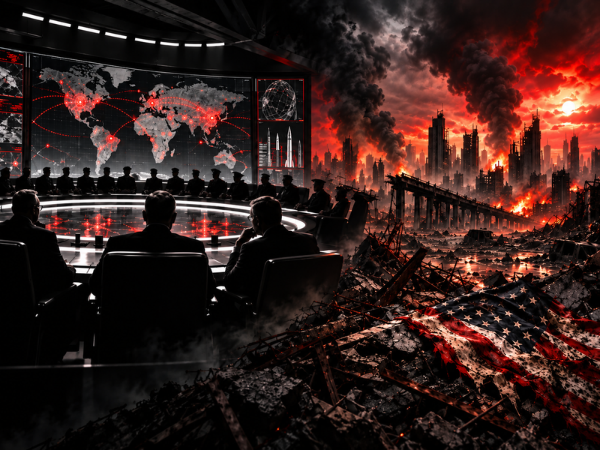
The Doomsday Government: Preparing for the End of the World, Not the End of Power

“Monsters in movies are us, always us, one way or the other... Monsters are us, the dangerous parts of us. The part that wants to destroy. The part of us with the reptile brain. The part of us that’s vicious and cruel. We express these in our stories as these monsters out there.”—John Carpenter
This time of year, there is no shortage of monsters to frighten us.
Hollywood has given us vampires, zombies, mad scientists, masked killers and creatures that emerge from the darkness to prey upon the unsuspecting.
But perhaps the most frightening monster of all is the government that has become so accustomed to wielding extraordinary power that it cannot imagine a future in which that power is diminished.
Enter the Doomsday Plan.
Imagine it: The power grid goes down. Supply chains collapse. Communications fail. Cities are plunged into darkness. Ordinary Americans are left scrambling for food, water, medicine and shelter.
Not to worry, though. The government has a plan for the coming apocalypse.
Unfortunately, the plan seems to have more to do with keeping the police state operational than keeping the American people alive.
In what sounds like a plot lifted straight out of Stanley Kubrick’s Dr. Strangelove, the Pentagon has unveiled an initiative designed to keep the war machine running even if a catastrophic war devastates the country’s civilian infrastructure.
Under an initiative called FORTRESS, the military is preparing major installations across the United States to operate independently for at least 90 days in the event of a catastrophic disruption. The plan includes portable nuclear reactors, independent power grids, stockpiles of fuel and ammunition, backup communications systems and arrangements for civilian factories to switch over to wartime production.
The Pentagon calls this preparedness.
The rest of us might reasonably wonder: what good is a government that can survive the end of the world if the people it was created to serve cannot?
This is the dark absurdity at the heart of Dr. Strangelove or: How I Learned to Stop Worrying and Love the Bomb, Kubrick’s 1964 satire about a collection of military commanders, politicians and bureaucrats who bring the world to the brink of nuclear annihilation while congratulating themselves on their strategic brilliance.
As civilization faces extinction, the men in charge begin discussing how a select portion of the population might survive underground in mineshafts, eventually emerging to rebuild civilization.
Naturally, the planners envision themselves among the survivors.
The resemblance to the present day is difficult to ignore.
Indeed, it sometimes seems as though the Trump administration has been watching every dystopian film and Cold War nightmare ever made and mistaking the villains for role models.
George Orwell’s 1984 gave us a surveillance state that watches everything and everyone. Aldous Huxley’s Brave New World imagined a population conditioned into compliance. John Carpenter’s They Live exposed a society manipulated by hidden powers, while Escape from New York envisioned an America where whole populations could be abandoned to incarceration and decay.
These works were supposed to serve as warnings.
Yet the machinery of government increasingly resembles the very dystopias they cautioned against: mass surveillance, militarized policing, automated systems of control, a presidency claiming ever-expanding authority, and now elaborate preparations to keep the military functioning in the event of societal collapse.
Of course, governments have a responsibility to prepare for emergencies. No reasonable person would argue otherwise. But there is a world of difference between preparing to protect the nation and preparing to preserve the power of those who govern it.
That distinction matters, especially when the same government that prepares for catastrophic war also helps create the conditions in which such wars become not only likely but imminent.
For decades, presidents of both political parties have pursued policies of military expansion, foreign intervention, escalating confrontation and permanent national emergency. The result has been an increasingly militarized national-security state that operates with fewer meaningful restraints and demands ever greater sacrifices from the American people.
We have been told that these extraordinary powers are necessary to keep us safe.
Yet the government’s answer to nearly every crisis—war, terrorism, civil unrest, economic instability, public health emergencies—has been more government power, more military involvement, more surveillance and fewer constitutional protections.
What happens then?
The government’s answer, at least in the newly announced FORTRESS initiative, is to make sure the military can continue fighting.
But what about the rest of us?
If the electric grid collapses, who will restore power to civilian communities? If hospitals lose electricity, who will keep patients alive? If food and medicine stop moving through the country, who will feed the population? If communications fail, how will families find one another? And if civil institutions cease functioning, who will ensure that emergency military authority does not become a permanent substitute for constitutional government?
This is precisely the kind of future the Pentagon is anticipating.
Consider the Pentagon’s chilling training video, Megacities: Urban Future, the Emerging Complexity, made public in 2016.
The video envisions a world of sprawling urban centers overwhelmed by poverty, disease, unemployment, overcrowding, failing infrastructure, environmental disasters and civil unrest.
It is a bleak portrait of the world as military planners fear it might look by 2030. In this vision of the future, cities become battlegrounds and the citizenry are viewed as the enemy.
As we warned nearly a decade ago, the military's vision of the future raises a disturbing possibility: that the people trapped in failing cities could come to be viewed less as citizens in need of protection than as obstacles to military operations.
As the video warns, there will be a need to “drain the swamps.” Only in this dystopian future, “we the people” risk becoming inhabitants of the swamp that military forces are preparing to clear out.
That is a dangerous way for any government to view the people it is supposed to protect.
It is particularly dangerous for a nation whose founders explicitly rejected martial law and enacted constitutional bulwarks to guard against the rise of a police state.
Yet this is where the country has been heading for years.
We’ve witnessed the steady militarization of domestic law enforcement, the expansion of surveillance networks, the deployment of military equipment into American communities, and repeated efforts to blur the line between policing and warfare.
Under the Trump administration, those boundaries have been tested even further through domestic military deployments, aggressive immigration enforcement and expansive claims of executive authority in the name of national security.
The message is increasingly unmistakable: the military is increasingly being presented as the solution to every domestic crisis.
Yet this is also why the Pentagon’s latest Doomsday preparations cannot be considered in isolation from the government’s longstanding continuity-of-government plans.
For decades, federal officials have maintained arrangements intended to preserve essential government operations during a catastrophic emergency, including secure facilities, alternate command centers, succession procedures and protected communications systems.
These preparations are hardly limited to military installations.
Even Trump’s controversial White House ballroom project includes plans for fortified underground facilities, bomb shelters, secure communications and medical facilities, ostensibly to ensure that the presidency can continue functioning during a national emergency.
The government is making elaborate preparations to preserve its leadership and military capabilities in the event of catastrophe.
Some of these measures are practical: a functioning government is essential to coordinating rescue operations, maintaining order and rebuilding after disaster. But continuity-of-government planning also raises a constitutional question that is too often overlooked: what exactly is being preserved?
The Constitution establishes a government of limited, divided powers, accountable to the people and constrained by law.
Preserving that government means more than ensuring that the president can issue orders, military commanders can communicate and federal agencies can continue operating. It means preserving the checks and balances that prevent power from becoming absolute. It means preserving Congress, the courts, due process, freedom of speech, freedom of the press and the right of the people to challenge government abuses.
It means ensuring that an emergency does not become an excuse to dispense with the very constitutional restraints that distinguish a republic from a dictatorship.
Otherwise, continuity of government becomes little more than continuity of power.
That danger is hardly theoretical.
The government has already spent the better part of the past quarter-century normalizing powers once considered extraordinary. For instance, the 9/11 attacks gave rise to the Patriot Act, warrantless surveillance, secret courts, indefinite detention, expanded executive authority and a sprawling homeland-security apparatus.
The emergency was supposed to be temporary. Instead, the machinery created in response to that emergency became a permanent fixture of American life.
Successive presidents inherited those powers, defended them and expanded upon them. The same pattern has been repeated with other crises, legitimate and manufactured.
What begins as an exceptional measure becomes the norm. What is justified as temporary becomes permanent. What is introduced as a safeguard against danger becomes another instrument of government control.
The public is told to trust the government to use these extraordinary powers responsibly. Yet the Constitution was not written on the assumption that those in power could always be trusted. It was written because they cannot be trusted.
This is the lesson that government officials, regardless of political affiliation, seem determined to ignore.
The founders understood that concentrated power is dangerous even when exercised by people claiming the best intentions. They also understood that military power, unless strictly constrained, could become an instrument of domestic tyranny.
That is why civilian control of the military, the separation of powers, due process and the protections enshrined in the Bill of Rights are not inconveniences to be discarded whenever the government declares an emergency.
They are safeguards against the abuses that emergencies make possible.
Yet what happens to those safeguards in the kind of catastrophic scenario the Pentagon is preparing for? When the infrastructure has collapsed. Communications are severely disrupted. Civilian agencies are overwhelmed. Courts may be unable to function normally. Congress may struggle to convene. Local governments may lack the resources to meet basic needs. Meanwhile, the military retains independent power, communications, supplies and operational command.
Under those conditions, who gets to make the decisions?
Who determines which communities receive assistance, which areas are secured, which movements are restricted, and which orders must be obeyed? Who decides when the emergency is over? And who has the power to say no?
The greater the crisis, the greater the temptation to abandon constitutional limits in the name of survival. And the more power the government acquires during an emergency, the less willing it tends to be to surrender that power afterward.
The government has become so consumed with preserving its power that it can plan for almost everything except its own accountability and restraint.
That is what makes the Pentagon’s doomsday planning so unsettling.
The problem is not that the military wants to keep the lights on during a national catastrophe. The problem is what happens when keeping the machinery of war functioning becomes the overriding measure of national survival.
A nation is so much more than its military installations, its command centers, its weapons systems or its political leadership. A nation is its people. It is families, neighborhoods, communities, schools, churches, hospitals and the countless institutions of civil society that make freedom possible.
It is also the constitutional principles that prevent those entrusted with power from becoming masters over those they were appointed to serve.
Without those things, there may still be a government. There may still be a military. There may even be a president issuing orders from some fortified command center. But there will be little left of the republic the Constitution was intended to establish.
So where does that leave us?
President Trump and his self-serving administration of war hawks have squandered so much of our resources, our goodwill on the world stage, and our role as a champion for liberty and justice. Now having pushed us to the apocalyptic brink of devastation, they’re building bunkers to save their own necks while the rest of us are left to fend for ourselves.
Enough is enough.
“We the people” should be demanding a government that works to prevent catastrophe, protects civilian life, respects constitutional limits and remembers that its continued existence is not an end in itself. And if they won’t march in lockstep with our expectations, throw the whole lot of them out.
Because as I make clear in my book Battlefield America: The War on the American People and in its fictional counterpart The Erik Blair Diaries, the danger comes when the government forgets that it exists to serve the people, not the other way around.
A government that survives by abandoning the people and the Constitution has not saved the country.
It has merely saved itself.
The Constitution was not written to ensure that the government would survive at any cost.
It was written to ensure that freedom would survive a tyrannical government.
WC: 2163
ABOUT JOHN W. WHITEHEAD
Constitutional attorney and author John W. Whitehead is founder and president of The Rutherford Institute. His most recent books are the best-selling Battlefield America: The War on the American People, the award-winning A Government of Wolves: The Emerging American Police State, and a debut dystopian fiction novel, The Erik Blair Diaries. Whitehead can be contacted at staff@rutherford.org. Nisha Whitehead is the Executive Director of The Rutherford Institute. Information about The Rutherford Institute is available at www.rutherford.org.
Publication Guidelines / Reprint Permission
John W. Whitehead’s weekly commentaries are available for publication to newspapers and web publications at no charge. Please contact staff@rutherford.org to obtain reprint permission.